


Published: May 07, 2025 | updated: March 03, 2026
Luke is the Head of Marketing at Sandfield with 10+ years of experience in Tech Marketing.
Insights + Blogs

Published: May 07, 2025 | updated: March 03, 2026
Luke is the Head of Marketing at Sandfield with 10+ years of experience in Tech Marketing.
Key insights:
While many modern suppliers and distributors have implemented integration solutions that have simplified their ordering process for their EDI-enabled customers, it has often meant that they are still relying on manual processes, such as email and phone, when dealing with customers without EDI capabilities.
Picture this: You are in charge of supply chain management for a large wine producer. You have a wide range of customers. Some of your customers are supermarket chains and international distribution companies. These companies have already established integration capabilities which allow them to fulfil their orders with you via automation. But, in addition to these customers, you also have a large number of customers (e.g. boutique wine shops and restaurant retailers) that do not have integration infrastructure. You still receive these customers' orders via email or over the phone.
This means that you have two distinct ordering processes, one of which involves time-consuming and potentially error-filled manual data processing.
What you need is a branded web interface that ensures all of the orders you receive from your non-EDI customers are automatically redirected to your internal systems—providing efficiency and simplification on your customers’ end and automation on yours.
Crossfire’s Customer Portal is a flexible and comprehensive way to streamline your incoming orders, regardless of how diverse your customer base is. The portal is a central hub that enables you to utilise automation when receiving orders from your retail partners, without having to rely on the modernisation of their own internal technology.
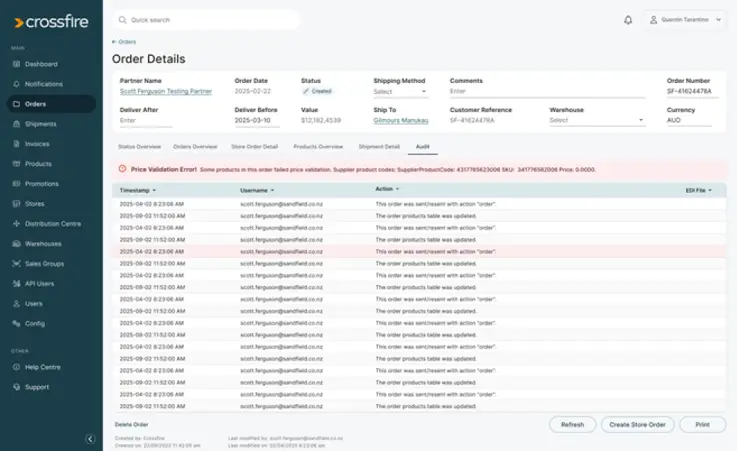
The Portal is an easy-to-use branded web-based EDI interface where your customers without EDI capabilities can place and manage their orders. This gives them control of the ordering process and provides a layer of visibility across shipment information that they didn’t previously have. It also simplifies the ordering process on their end and provides an attractive interim solution until they are able to implement their own internal EDI integration solution.
On your end, the portal basically ensures that orders from customers who are not EDI-enabled are processed using the same automation tools that have been implemented to manage the orders from your integrated trading partners.
All orders received through the portal automatically flow directly into your internal ordering and inventory systems, reducing the need for manual processing and giving you better forecasting clarity with all of your trading partners.
This has no direct impact on your retailers who are already utilising EDI integrations. They continue to place orders through their own internal systems, which automatically forward the order to your internal systems for processing.
Crossfire’s Customer Portal provides a number of benefits, including:
Crossfire’s Customer Portal is easy to implement and doesn’t require significant changes from your customers in order to adopt.
Find out how the Portal can help you remove friction and complication from the ordering process, reduce costs and provide a seamless interface for your customers, irrespective of their technical resources. Get in touch to see a demo today.
You can automate orders from non-EDI capable customers by using a branded web-based Customer Portal. This portal acts as a central hub where customers who typically order via phone or email can place orders through a user-friendly interface. These orders are automatically converted into a format compatible with your internal inventory and ordering systems. This setup eliminates manual data entry errors, provides customers with real-time shipment visibility, and ensures all incoming orders follow a streamlined, automated workflow regardless of the customer's technical infrastructure.
The portal acts as a central hub that offers several advantages:
No. Existing trading partners who already use EDI integrations will continue to place orders through their own internal systems. The Customer Portal is a complementary solution designed specifically for your non-integrated customers, ensuring that all incoming orders - regardless of the customer's technical capability - flow through the same automated process.


© Copyright 2026 Sandfield Associates Limited. All Rights Reserved. Terms of Use | Privacy Policy

